
Gantry System Bridges the Gap Between Conveyor System and AGVs
WM Kelley has worked with major, International tire manufacturers and their partners for years. We are familiar with handling everything from baled synthetic rubber to the finished tires.
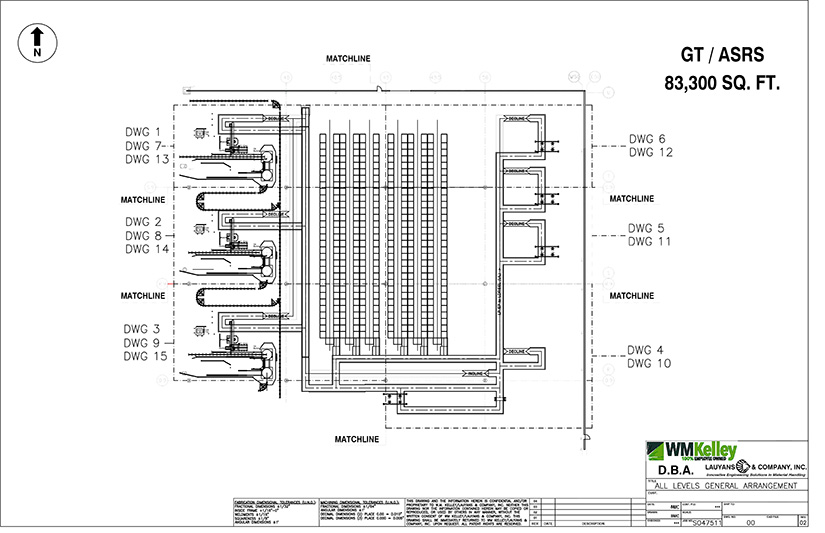
Our customer is building a new plant to produce automotive tires. The system begins with the newly manufactured tires that leaves them as “green,” or uncured tires. The green tires are moved through an Automated Storage and Retrieval System (ASRS) to a series of gantry cranes. The gantry cranes remove the green tires from specialized pallets and place them on Automatic Guided Vehicles (AGVs). The AGVs take the green tires to the vulcanizing operation. This process uses a combination of pressure and heat to mold the tread onto the tires and cure them. Once vulcanized, the tires are ready for use.
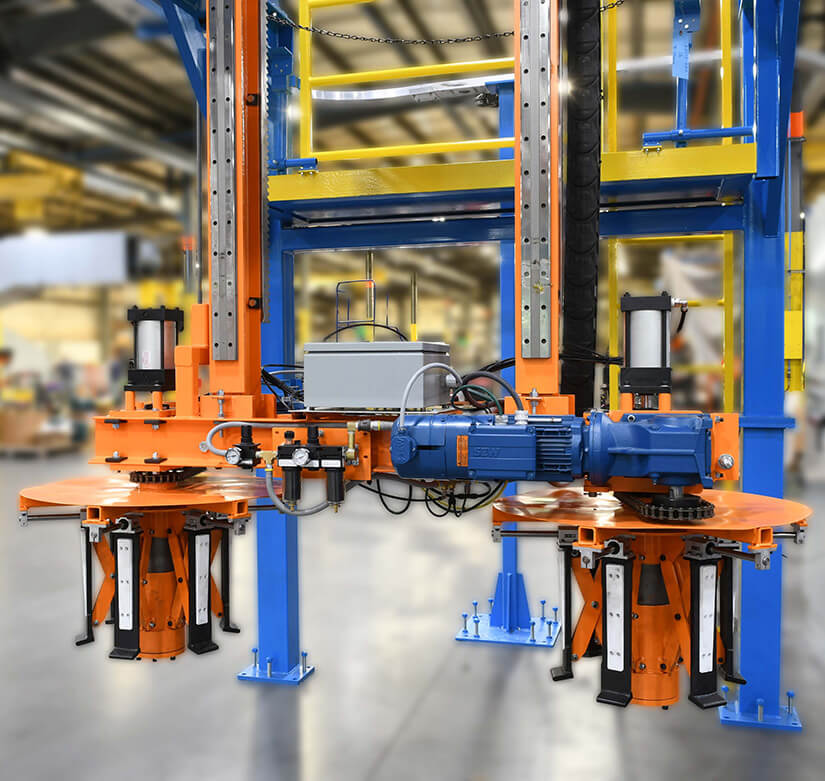
Each gantry crane is designed to pick green tires from formed pallets and deposit them onto an adjacent AGV. The station is equipped with two pickup heads.
The loading cycle begins when two pallets with green tires enter the gantry envelope on a conveyor system that has also been manufactured by WM Kelley. Both pallets are properly positioned on the conveyor to allow for interface with the gantry system. Sensors indicate to the gantry control system when the pallets are present and in position. An AGV which has been dispatched by the Material Handling Control System (MHCS) arrives at the pallet loading station. When the vehicle arrives, it communicates with the loader controller. The vehicle sends an interlock signal to notify the loader that it is ready to receive a pair of tires. The vehicle then waits until it receives a signal from the loader that it is clear to enter the load station.
Once the vehicle receives the Clear To Enter signal, it travels to the load point and aligns itself using onboard sensors. The vehicle then signals the loader that it is ready to receive a pair of tires. When the loader receives this signal, the cycle of transferring tires between the conveyor system and the AGV system begins.
The loaders are furnished with a bar code scanner on each pickup head. These scanners are used to locate and read a bar code label affixed to the side wall of the tire. At the beginning of the load cycle, the robotic loader will extend the gripper mechanisms down inside the bead diameter of the tires on each pallet and lift the tires from their pallets. The green tire is sticky. WM Kelley has designed each pickup station with a lock that captures the pallet during the removal of the green tire, insuring that the tire comes away cleanly. The Tire End Effector Legs are coated with Teflon, so the green tire won’t stick. In the full up position, the gripper mechanism will rotate the tire past its associated scanner to find the location of the label on the tire. The scanner will read the label and transmit its location and its identification information to the conveyor system PLC.
When the loading cycle is complete, the loader will give the AGV a signal that it is clear to leave. Upon receiving this signal, the vehicle travels to the vulcanizing press which requested the tires. The gripper mechanisms are returned to their home position to await the beginning of the next cycle. The pallet is returned to the system.